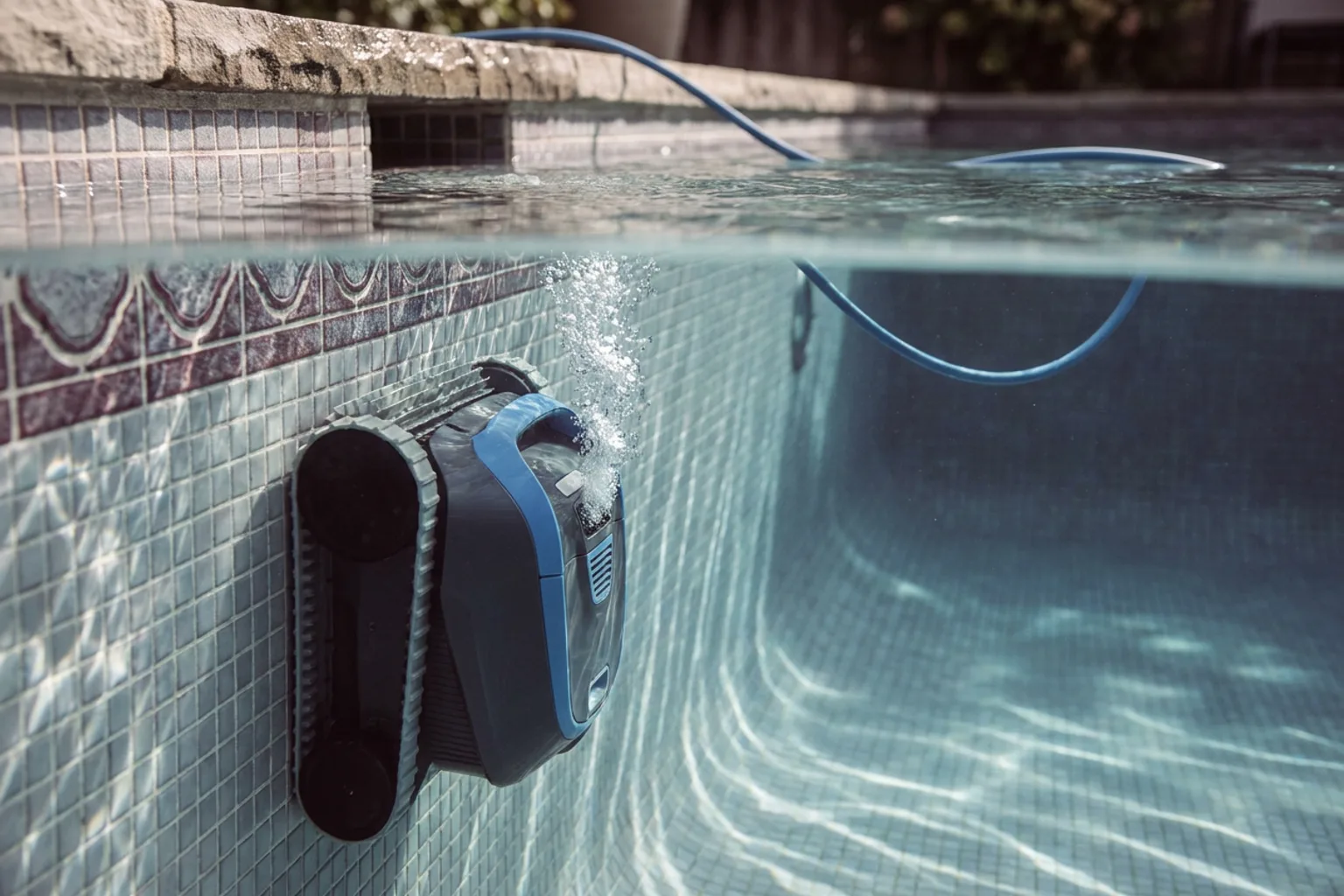
Robotic pool vacuums work as self-contained cleaners. An onboard pump pulls water and debris through openings on the underside into a built-in filter, while drive motors move the robot across the floor and up the walls on tracks or wheels. It runs on low-voltage power from a floating cable or an internal battery and steers with onboard sensors and preset patterns. It never sends debris to your pool's own filter.
Everything else builds on that basic loop, from wall climbing to the differences between corded and cordless models.
One cleaning cycle, step by step
- Power. On a corded robot, the power supply sits on the deck and plugs into a GFCI-protected outlet. It converts 120-volt household current into low-voltage DC that runs down the floating cable. A cordless robot starts on a battery charged out of the water.
- Sinking. You lower the robot in, let trapped air bubble out, and it settles to the floor.
- Suction. A pump motor spins an impeller that draws water through intake ports underneath. Debris stays in the filter, and filtered water exits through a vent on top.
- Scrubbing. Rotating brushes loosen dirt and film so the intake can grab it.
- Driving. Drive motors turn the tracks or wheels while sensors register walls, slopes and turns.
- Climbing. If the mode includes walls, the robot climbs, scrubs toward the waterline and comes back down.
- Stopping. A timer or the battery ends the cycle. Depending on the design, the robot then parks on the floor, at a wall or at the surface.
The main parts and what each one does
| Part | Job | What to check on the spec sheet |
|---|---|---|
| Pump motor and impeller | Creates suction, plus the outflow that presses the robot against surfaces | Flow rate (gallons per hour), if listed |
| Drive motors | Move and steer the robot | Number of drive motors |
| Tracks or wheels | Grip the floor and walls | Rated for your pool surface |
| Brushes | Loosen dirt and film | Type suited to plaster, pebble, tile, vinyl or fiberglass |
| Onboard filter | Holds debris inside the robot | Coarse vs. fine options; top or bottom access |
| Sensors | Detect walls, tilt and heading | Gyroscope, accelerometer or other sensors |
| Power | Cable and power supply, or battery | Cable length, or runtime and charge time |
| Swivel (corded models) | Lets the cable rotate to limit tangles | Whether one is built in |
How a pool robot climbs walls
The water flow that does the cleaning also holds the robot in place. The pump pulls water in underneath and pushes it out the top, and that outflow presses the robot against whatever surface it's on. Tracks and brushes supply the grip, and the push keeps them in contact.
A tilt sensor or accelerometer tells the robot when it has gone vertical. Near the top, the robot has to find where the water ends, and models handle this in one of three ways:
- It notices the change in pump load as the intake starts pulling air.
- It uses a dedicated waterline sensor.
- It climbs for a set time before backing down.
Some models then travel sideways along the waterline to scrub the tile band, where oils and scum tend to collect.
Not every robot cleans walls. Some clean only the floor, and many offer separate floor-only and full-pool modes, so check the listing for what you're getting.
How it finds its way around
Most pool robots don't build the kind of detailed map you get from the lidar and camera mapping floor robots use. Bubbles, cloudy water and shifting light make seeing underwater hard, so pool robots rely on simpler methods:
- Bump-and-turn patterns. The robot drives until it reaches a wall, turns at an angle and repeats. Given enough time it reaches most of the pool, but coverage is uneven.
- Systematic patterns. A gyroscope and accelerometer let the robot hold a straight line, turn by a measured angle and work the floor in lanes.
- Extra sensors. Some models add ultrasonic or optical sensors to spot walls and obstacles before contact.
Steps, benches, swim-outs, tanning ledges and tight freeform corners are where robots most often leave dirt behind. If your pool has several of these, look for explicit claims about steps and ledges. Don't assume "full pool cleaning" covers them.
App control has to work around one constraint: radio signals barely travel through water. Corded models with Wi-Fi or Bluetooth usually put the radio in the power supply and send commands down the cable. Cordless models generally connect only at or near the surface. Check how the app reaches any model you're considering.
Where the dirt goes
Because the robot filters its own water, floor debris never reaches your skimmer basket or main filter. Suction-side cleaners, by contrast, send everything there. The flip side is that you empty the robot's filter after every run.
Filters come as baskets, cartridges or panels:
- Coarse filters handle leaves and larger debris.
- Fine filters trap dust, silt and pollen but fill faster, and a full filter cuts water flow and suction.
Some brands list a micron rating; the lower the number, the finer the particles a filter catches. Top-access filters let you pull the basket without flipping a wet robot over.
The robot isn't part of your circulation system. It doesn't sanitize the water or replace your pump's daily run time. Most models also don't skim floating debris, though a few add surface skimming.
Corded vs. cordless
| Corded | Cordless | |
|---|---|---|
| Power | Low-voltage DC through a floating cable | Rechargeable battery, charged out of the pool |
| What ends a cycle | The programmed timer | The timer or the battery running low |
| Setup | Place the power supply, lay out the cable | Charge it, drop it in |
| Retrieval | Guide it to the wall, lift it by the handle | Varies: some surface or park at a wall; others need a retrieval hook |
| Typical hassle | Cable twists and tangles | Charge time; battery wear over the years |
To size a cable, measure from where the power supply will sit to the farthest bottom corner of the deep end. Depth counts, not just length.
Robotic vs. suction-side vs. pressure-side cleaners
Robotic cleaners are one of three common types of automatic pool cleaner. The other two borrow power from your pool's plumbing.
| Type | Powered by | Debris goes to | Main pump must run? |
|---|---|---|---|
| Robotic | Its own motors | Onboard filter | No |
| Suction-side | Suction through the skimmer or a dedicated line | Skimmer and pump baskets, then the main filter | Yes |
| Pressure-side | Return-line pressure, sometimes with a booster pump | Its own debris bag | Yes |
The robot's main advantage is independence: there are no hoses to hook up and no extra load on the pool filter. The tradeoff is handling, since you carry it in and out and clean its filter yourself.
What to do after every cycle
- Lift it by the handle, never the cable. Guide it to the wall, then raise it slowly so water drains out. It weighs far more full of water than its listed weight.
- Empty and rinse the filter. A garden hose usually does the job. Deep-clean the filter when rinsing no longer clears the mesh.
- Check brushes and tracks. Remove hair and string, and look for worn bristles or slick tracks, because worn parts slip.
- Straighten the cable. On corded models, uncoil it fully so twists relax before they turn into knots.
- Store it in the shade. UV light breaks down plastics and cable jackets, and a caddy keeps the robot off the deck. Charge cordless models as the manual directs.
Checklist: what to confirm before you buy
- Pool type and size: in-ground or above-ground, and within the robot's rated size and shape.
- Surface: brushes and tracks suited to your pool's finish.
- Coverage: floor only, or floor, walls and waterline; any claims about steps and ledges.
- Power: a cable that reaches your farthest corner, or a battery runtime that covers a full cycle, plus charge time.
- Filters: coarse and fine options, a micron rating if listed, and top access.
- Handling: listed weight, how the robot ends a cycle, and whether a caddy is included.
- App and scheduling: worth paying for only if you'll actually use them.
- Service: warranty length and coverage, and whether brushes, filters, tracks and power supplies are sold in the US.
Pool robots vs. floor robots: same idea, different physics
A floor robot moves air with a fan and often navigates with lidar or cameras. A pool robot moves water with a pump, uses that flow to stick to walls and navigates mostly by feel. Both handle routine upkeep rather than every job, so set expectations the same way you would for what indoor robot vacuums can and can't do. If you're also choosing a robot for inside the house, the robot vacuum finder helps narrow down models for your home and cleaning needs.